It’s a scourge. One that has persisted for years. And one that’s difficult to combat. Buying streams has been a well-known tactic since the explosion of music streaming. And with the arrival of Artificial Intelligence, the issue has resurfaced more than ever. Fake streams: why, how, and what are the consequences? Let’s take a closer look!
Fake streams: why, how, and for what consequences
The music industry is a world where you have to exist at all costs. Be visible and stay visible, or risk being swallowed up by your competitors. Where numbers reign supreme and where success breeds success. Despite all the talk about artistic quality, it’s often the number of streams and followers that count. Why? Because algorithms love success and statistics. And in 2025, as they have for many years, algorithms dominate everything. Amassing streams leads to even more. The machine is constantly hungry and needs to be fed. In this context, manipulating these figures by buying fake streams is tempting. Especially since the more streams there are, the higher the royalties.
The method is relatively new but aligns with the upheaval brought about by the advent of the internet. With piracy and online music streaming, albums and songs have been caught in a cycle that is as infernal as it is ultimately liberating. Everything has changed: the relationship with art, consumption patterns, and the race for numbers has intensified.
With the rise of streaming platforms and the need to play by their rules to remain relevant in the media landscape, questionable practices have emerged. As we’ve said, the music world has also become a numbers game. Those displayed on an artist’s Spotify profile page have, in this context, become markers of quality in many people’s minds. If an artist is listened to by hundreds of thousands or millions of people, then they must be making quality music, some of us think. We’re – sometimes – wrong.
And it doesn’t matter if these “monthly listeners” don’t accurately represent an artist’s audience, or if these figures fluctuate from month to month and are misleading. What matters now is that they exist. And that they are as impressive as possible.
Fake streams: why, how, and for what consequences. What are those?
How do you stand out among the hundreds of thousands of artists out there? How do you build an audience and attract attention? Get into playlists and create the illusion of success? For established artists: how do you maintain that success and mask potential drops in streaming numbers?
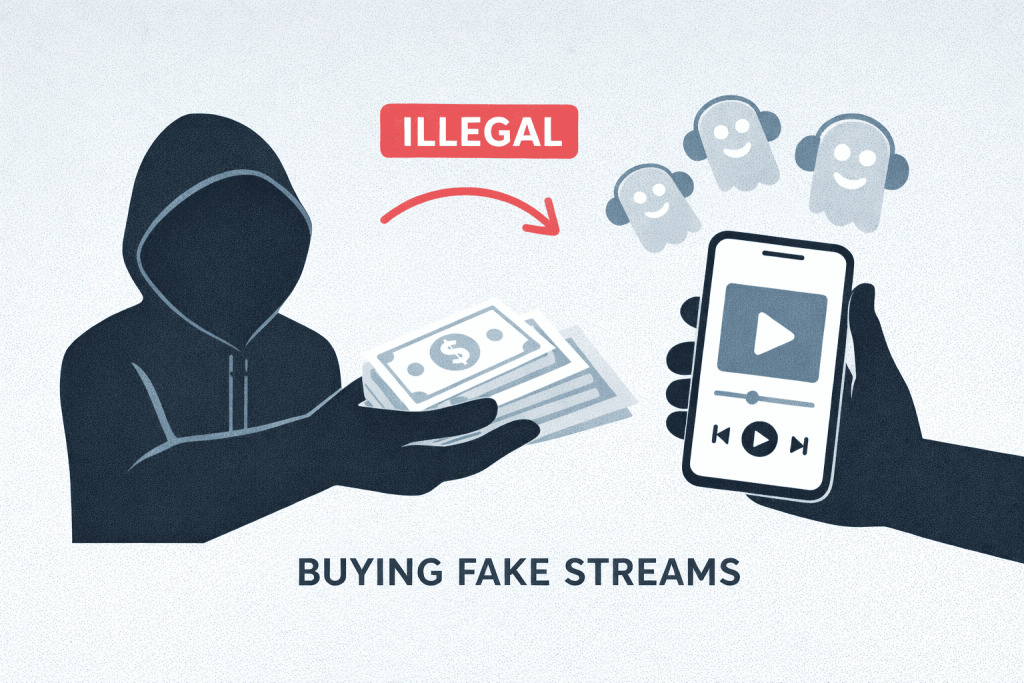
For some, the answer lies in two words: fake streams. But what exactly are fake streams, and how do they work?
Many companies promise the moon and the stars: a set number of streams for a ridiculously low price. A price almost anyone can afford. It’s tempting. Especially when, as an independent artist, you’re struggling to see your numbers grow. If you sign up with them, these companies all operate in the same way: they use bots that mimic human actions. In short, robots will listen to your songs and artificially generate streams. Computer programs are designed to repeat a task over and over again, without stopping, and faster than a human can.
Or perhaps they are real humans, gathered in what are called “click farms,” who are paid a few cents to do the same thing as the bots. These are in no way fans or listeners, but people paid to create very real, but fraudulent, statistics. By the millions.
Fakes and battles
And if you think that fake streams are only the domain of up-and-coming artists, think again. Major labels have been guilty of such practices. Some have even included them in their marketing and development strategies over the years. Buying streams at the time of an album release is a smart way to generate attention and give the illusion of massive popularity. And for years, starting in 2021, according to experts, it worked.
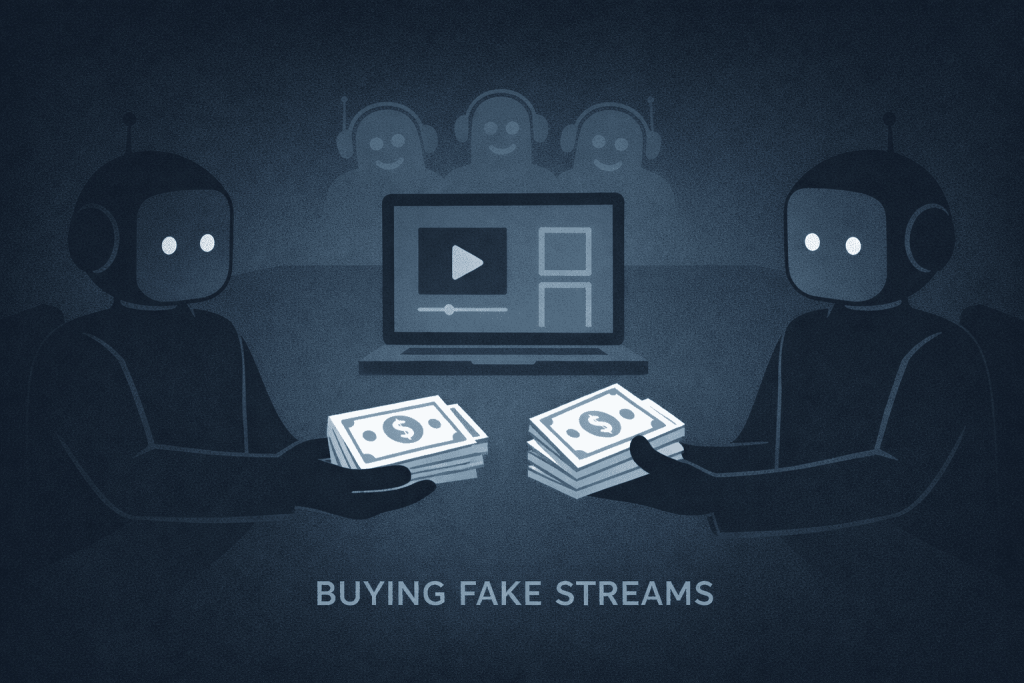
So much so that the secret was no longer kept, but firmly entrenched in people’s minds. Very few concrete cases have emerged: labels and artists all deny using such tactics. Admitting it would be close to admitting they are cheating and would damage their credibility. But no one is fooled. The battle sometimes rages even at the highest levels of the music industry. Drake, a rapper engaged in an open conflict with Kendrick Lamar, fueled by clashes, videos, and attempts at intimidation, accused UMG of artificially inflating the streams of Kendrick Lamar’s song “Not Like Us.”
This song, aimed at Drake, was released in 2024 and quickly became one of the year’s biggest hits. UMG vehemently denied the accusations, and a trial was held, ultimately ruling in UMG’s favor. The case ended there, but it demonstrates the extent to which fake-stream strategies have been internalized by the world’s most prominent artists, to the point of brandishing them as justification for losing a dispute.
Stats!
In 2021, the CNM, a French organization, revealed that between 1 and 3% of streams generated in France by Spotify, Deezer, Qobuz, and other labels and distributors were fake. That’s between 1 and 3 billion streams. And all of this is just within France. Spotify confirmed these figures, estimating that 1.14% of the streams in its catalog were fraudulent. And this only represents the streams that could be detected.
The CNM specifies in its study that the rap genre is by far the most affected by these problems. Given that it’s the most-streamed genre in the world, the figures are staggering. Bloomberg goes even further: in 2023, they estimated that globally, 10% of streams would be fraudulent, representing $2 billion in misdirected revenue.
Services like Beatdapp have even emerged, offering their detection services to any platform that wants them. But even they sometimes struggle to detect all fake streams. Over time, these companies’ tactics have become so sophisticated that they are increasingly difficult to detect.
Fake streams are a reality. Well-established and widely acknowledged. Except that after the initial excitement, the consequences are real.
Fake streams: why, how, and for what consequences? The impact.
For those who buy fake streams, the consequences can be disastrous. Unequal distribution of streams, lost revenue for legitimate artists, blurred lines, and negative public perception are just some of the many impacts.
The phenomenon has become so widespread that Spotify has dedicated a page in its “Spotify for Artists” section to artificial streaming.
They explain, like all other music streaming platforms, that they have invested in tools to detect fake streams. The aim is to remove them and to penalize, both financially and in terms of visibility, the labels and artists found guilty of such practices. Algorithms would no longer detect them, or detect them less effectively; royalties would not be calculated on these fake streams; songs would be removed from playlists; and accounts could be suspended and banned.
This is a global issue that affects the entire industry. Because fake streams disrupt a redistribution system that’s already skewed towards artists. The system primarily operates on a royalty pool. Revenue from all streams is deposited into this pool and then redistributed according to each artist’s share. If they go undetected, fake streams artificially inflate this pool and divert a significant portion of revenue from legitimate artists.
Across all platforms
And let’s not even mention buying fake followers on social media or fake YouTube views. The consequences are similar. Instagram, for example, has implemented tools to detect accounts that have purchased fake followers. These accounts’ pages are de-indexed, and the social network’s algorithm penalizes them. The result? Near-total invisibility. And engagement rates, the key to any strategy, plummet.
Regaining favor with the algorithm then becomes extremely difficult, if not impossible. The same phenomenon applies to fake YouTube views; they, too, are a marker of popularity. Unlike fake music streams, these are easy to spot. Just look at the number of likes and comments. It’s not uncommon, given the widespread practice, to see hundreds of thousands of views under a video title, with only a few comments. Everything is detectable, and ultimately, everything has a price.
Proof: In 2024, a man in Denmark became the first person officially convicted for buying fake streams. He was sentenced to prison after earning the equivalent of £229,676 from fake streams. A historic conviction that also proves the judicial system is on its way and trying to enforce the law.
Fake streams: why, how, and for what consequences? The actions
While fraudsters’ tactics are becoming more sophisticated and seem poised for further development, a revolt is brewing. In addition to barriers imposed by streaming services and third-party apps, the streaming services themselves are taking action.
This is the case with Deezer, which has partnered with UMG and other organizations to combat music fraud, particularly the proliferation of AI. This is the other major issue of our time: while fraud previously took the form of fake streams generated by real artists, fake artists, entirely created by AI, are also emerging. And the examples are numerous.
Beyond all the ethical and copyright issues this raises, these AIs also disrupt revenue distribution, further weakening the compensation system by adding to the problem of fake streams. Is the music industry a victim of its own success? Has it created a monster it can no longer control? Not quite. At the height of piracy, the industry was slow to react and failed to put in place the safeguards needed to combat its proliferation. Today, platforms seem better prepared.
The defenses are fragile, but numerous initiatives, such as those by Deezer, Apple Music, and Spotify, help limit the impact of fake streams on the music industry.
Nevertheless, some artists and labels still manage to slip through the net. But for how much longer?