Four letters and a thousand controversies. For two years, the word “Suno” has generated as much outrage as interest and tension. Two years of controversy, lawsuits, promises, and debates. And two years of success. Colossal. The huge success of Suno in numbers: we tell you everything you need to know.

Estimated reading time: 9 minutes
The huge success of Suno in numbers – A bit of background
Two years ago, we dedicated an article to Suno, detailing the controversies that have marked the service’s recent history. Two years later, our opinion hasn’t changed: we’re far from being the biggest fans of the model Suno offers. Quite the opposite, to be honest. As music enthusiasts, attentive to the protection of artists’ rights, it’s difficult for us to rejoice in Suno‘s enormous success since its launch.
Because that’s precisely what it is: a resounding success, beyond dispute. This article, therefore, aims to take stock of Suno’s recent developments, not to celebrate these milestones, but rather to analyze what they reveal about our modern societies and the music industry. About our consumption habits, how we treat artists, and the future that all of this might create.
It is also important, from our perspective, to stay informed about the advancements of Artificial Intelligence in the music industry. Not to criticize it systematically: it can also, when used properly, be a source of great things. But to try to keep up with its evolution and understand how it is revolutionizing everything, forcing us to adapt our habits and, at Soundiiz, our services.
Suno‘s purpose
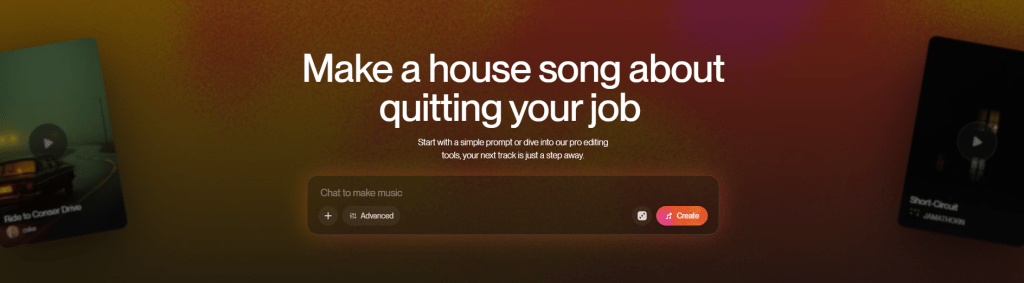
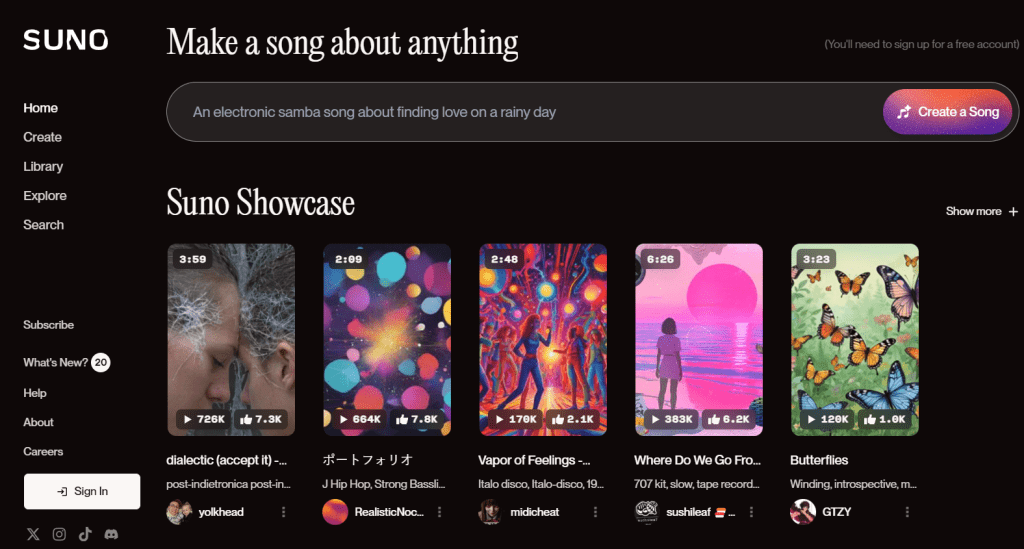
In short, Suno is an AI-powered music generator. It allows users to create ready-to-listen and share songs from pre-existing musical and vocal elements, which they can manipulate as they wish by entering lines of text that correspond to what they want to produce. Basic, straightforward, ergonomic, and easy to use: Suno’s formula is unbeatable. Like many artificial intelligence models, Suno trains and refines itself using copyrighted songs, so it shouldn’t have the right to use them without the consent of the legal representatives.
The situation is completely opaque: Suno refuses to disclose the data on which it bases its model, creating numerous controversies and even a high-profile lawsuit from the Recording Industry Association of America (RIAA). Since then, Suno has reached a settlement and signed licensing agreements with Universal Music Group and Warner. Unfortunately, the exact details of these deals remain unclear.
Open letter
Artists and musicians regularly speak out against Suno and the outright theft of their data: statements in the media and on social networks, open letters signed en masse—actions are multiplying. The name of the campaign? “Say No to Suno.” Quite clear. Released on February 23rd, the open letter, signed by artists, producers, label executives, and others, aptly summarizes the frustrations surrounding the development of Suno. It serves as a mirror of the perceived dangers of AI in artistic creation.
The context is indeed alarming: a recent report from Deezer states that approximately 60,000 songs are uploaded to the platform every day. And that’s just on Deezer. Even though the French service is used worldwide, it is far from being the most used platform in terms of user numbers. AI is gaining ground, and increasingly so.
It wouldn’t be surprising if, in the coming months or years, more than half of the songs uploaded to streaming services were AI-generated. While the numbers are staggering, some things are moving in the right direction for artists, but others are heading in the opposite direction. And they’re moving fast, very fast.
The huge success of Suno in numbers – A growing success
On February 25th, Suno CEO and co-founder Mikey Shulman shared some pretty wild news on his Reddit account. He claimed that Suno had just surpassed 2 million paying users. He added that just two years after its launch, the platform had attracted over 100 million people. The result? $300 million in revenue. That’s $100 million more than the Wall Street Journal’s projections published in late November 2025.
Is Suno growing faster than even the wildest predictions? It certainly seems so. These figures are a sign of the service’s robust health, but also proof that the accusations leveled against it aren’t slowing its growth. On the contrary.
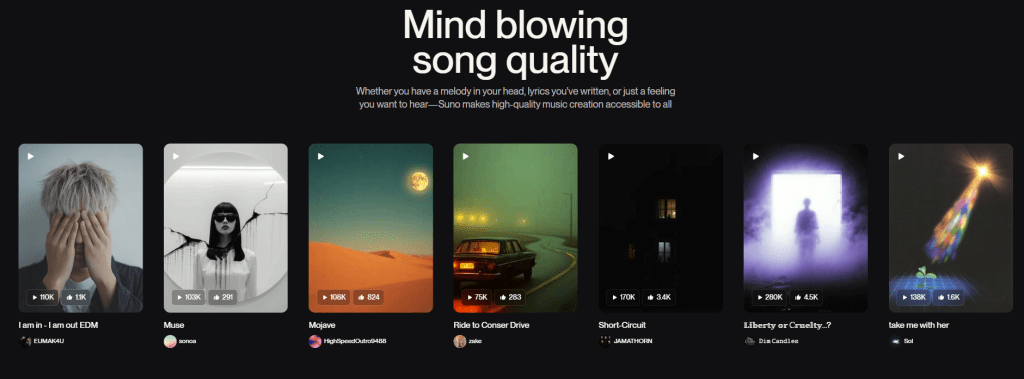
You’ve all surely seen it recently: Suno is flooding social media with ads, touting its services. They’ve also partnered with legendary producer Timbaland, who has been consistently praising Suno, saying it saves him considerable time on his productions. Timbaland’s stance has been widely debated and has generated thousands of hateful messages, but no matter: Suno’s strategy is working. And it’s working on a massive scale.
Especially since it’s unlikely Suno will stop now. Money is flowing freely, and after a $250 million funding round at the end of 2025, bringing its market capitalization to $2.45 billion, the teams have the means to look to the future with confidence. And the means to finance their ambitions.
Especially since the company continues to recruit executives from the music industry, including a former Spotify executive.
An all-out war!
According to its CEO, Suno is on a mission to save culture. He describes it as boring, homogenized, and predictable. Public tastes are supposedly predictable and, ultimately, stagnant. So, we should offer them something else. More creative music that would shake up the prevailing monotony. And there would be no reason why this same audience couldn’t contribute to the creative process with their own ideas.
From reading and listening to him, Suno would seem to have an almost social dimension. Democratic. By putting everyone on the same level, artists and ordinary listeners alike. Music would be meant to be in the hands of the greatest number. While his reasoning isn’t compelling, and while we agree that the act of creating is beneficial and should benefit everyone, regardless of means or skills, SUNO overlooks one thing: AI can be beneficial if it’s used within a legal framework.

That is to say, one that respects the rights of the artists who created the music used to power Suno and to allow everyone to become a musician. The very foundations of the model are shaky, illegal, and run counter to this desire, whose authenticity is not in doubt, to make music a social act and a means of sharing.
The huge success of Suno in numbers – What’s next?
In September 2025, SUNO reached a new milestone: the launch of Suno Studio, presented as “the first-ever generative audio workstation.” It takes song editing to the next level, leveraging professional tools and Suno’s AI. All of this is made possible by a new music-creation model that underpins the company’s ecosystem. These significant technological advancements demonstrate SUNO’s commitment to perfecting its offerings and its willingness to invest substantial sums. Further, more precise, more ambitious.
Recent fundraising rounds are financing these ambitions on a large scale. Suno doesn’t intend to stop there. And they seem to be literally at war with streaming platforms. They don’t hesitate to name names: to justify the usefulness of their services, they claim that Spotify only offers the same songs, on repeat. Trapping listeners in an endless loop of algorithmic recommendations, preventing them from discovering other artists and genres.

Suno essentially argues that streaming platforms are already relics of the past and that we must move beyond them and embrace other things. In other words, stop listening to songs created by real artists and producers and turn to an endless pool of AI-generated tracks, possibly made by anyone. Bad Bunny? Not for SUNO; they prefer to listen to what their retired neighbor, a former management controller and Suno user for the past two months, has created. We are, of course, simplifying and deliberately exaggerating, but the underlying message isn’t far from the truth.
A new revolution?
But what’s behind these statements? The launch of a streaming platform, nothing less. Rumors have been circulating for months, but the release seems imminent. It would be a genuine game-changer. A launch that could potentially revolutionize the world of music and streaming, given Suno’s recent figures. Enough to establish a new model?
It’s still too early to say: the details of this new platform are still unclear, and no launch date has been announced. We could therefore be faced with a philosophical choice: as music lovers, what matters most? Supporting human creativity or being entertained? If songs generated via Suno are of equal quality to copyrighted tracks available on Spotify, Deezer, Apple Music, YouTube Music, TIDAL, and elsewhere, what will we choose?

At Soundiiz, we know where we stand, but many others wouldn’t mind listening to most of their music on Suno. These decisions must be respected: this is the heart of the debate surrounding AI. Now too powerful to be stopped, it forces us to confront our opinions and choices. And Suno is a perfect example of this.