This is THE tech news of the week, maybe even the month. Two tech giants, Spotify and Claude, an Artificial Intelligence, can now work hand in hand. And the possibilities seem endless. Spotify, Claude & AI: are next-generation playlists here?

We’ll try to explain the ins and outs of this major shift!
Key takeaways
- AI-generated playlists are becoming central in music streaming, helping users discover songs faster by leveraging algorithms and personalized recommendations instead of manual browsing.
- Spotify’s AI playlist feature and its integration with Claude enable users to generate playlists or music recommendations directly from natural language prompts, based on mood, context, or listening history.
- The Spotify x Claude integration marks a shift toward conversational music discovery, where AI assistants act as a control layer to search, play, and manage playlists without leaving the chat interface.
- AI playlist generators like Soundiiz offer an alternative approach by remaining platform-independent, allowing users to generate and export playlists across multiple streaming services.
AI-generated summary
Estimated reading time: 9 minutes
What’s Claude?
In 2021, employees of OpenAI, the company behind ChatGPT, left to found Claude. Two years later, their brainchild hit the market and disrupted an already booming industry.
Behind Claude? Anthropic, a company in which Amazon and Google have invested billions of dollars. It has quickly established itself as one of the most reputable and effective AI models on the market. But it also attracts its share of controversy, particularly at the military and federal levels. By introducing a model designed to be ethical and transparent, notably through what Anthropic calls “Constitutional AI”—a list of principles that the AI must apply—Anthropic is attempting to establish new rules.
These principles, regularly refined, try, for example, to prevent Claude’s responses from hindering democracy. This almost philosophical, societal guide, which, of course, still has its flaws, differentiates Claude from other AI systems dominating the market.
The aim of this article is certainly not to engage in philosophical debates on the ethics of Artificial Intelligence. Still, it is important to highlight, to understand how Claude integrates with Spotify, the specific features of the tool developed by Anthropic.
In 2026, Claude and its numerous evolutions continue to influence the tech world and refine its technologies. A few days ago, Claude reached a new milestone: the ability to integrate its services into numerous globally recognized applications, such as Audible, TripAdvisor, Uber, Uber Eats, StubHub, and… Spotify.
And that’s where things start to get interesting!
It’s worth noting that Anthropic specifies that data from the connected applications will not be used to train Claude’s models, and also that these applications do not have access to other queries made by a user to Claude: a way for Anthropic to further position itself in the niche of “ethical” AI.
Spotify, Claude & AI: Are next-generation playlists here? Spotify and AI
As you know, and as we’ve discussed at length in our blog posts, Spotify has invested heavily in AI over the past few years. Probably even more than Apple Music, TIDAL, YouTube Music, Amazon Music, or Deezer. Spotify has always strived to be at the forefront of trends, aiming for a significant competitive advantage. And AI is no exception.
It all started with its algorithm and automated recommendation system. By investing millions of dollars in research and technological development, Spotify gained a considerable lead in its discovery playlists and user-based recommendations. Simply put, today it would be difficult to argue that Spotify doesn’t offer the best algorithm on the market. But you know the Swedish company: it didn’t stop there.

And AI has infiltrated Spotify, creating numerous controversies, proliferating, and tarnishing the streaming platform’s reputation. Once celebrated for the quality of its discovery playlists, the platform has now become the big bad wolf, the embodiment of AI’s excesses and its dangers to artistic creation.
So, how can this be countered? How can we regain control over AI and ensure it can once again be an asset rather than a factor that does more harm than good in terms of image?
By refocusing it where it creates the most value: playlists. And by investing in Claude.
Spotify, Claude & AI: Are next-generation playlists here?
At the end of April 2026, Spotify celebrated its 20th anniversary and made headlines in many ways. One of these was the announcement that its services now integrate Claude, one of the world’s most widely used conversational AI tools. This applies not only to Spotify Premium subscribers but also to those using the free version of the platform—something for everyone.
So, how does it work? It’s quite simple.
Claude users can now directly ask the AI a question, request music or podcast recommendations, or playlists. Using Spotify’s technology, Claude then suggests tracks that match the request.
Users can then either play them directly in Claude, via a preview window, or listen to them in their Spotify app. For example, you can ask Claude to generate a playlist that matches your mood or a specific moment in your day—whether it’s an evening with friends, a sunny drive in your car, or just before you start a workout. Note that this playlist generation feature is only available with a Spotify Premium subscription.
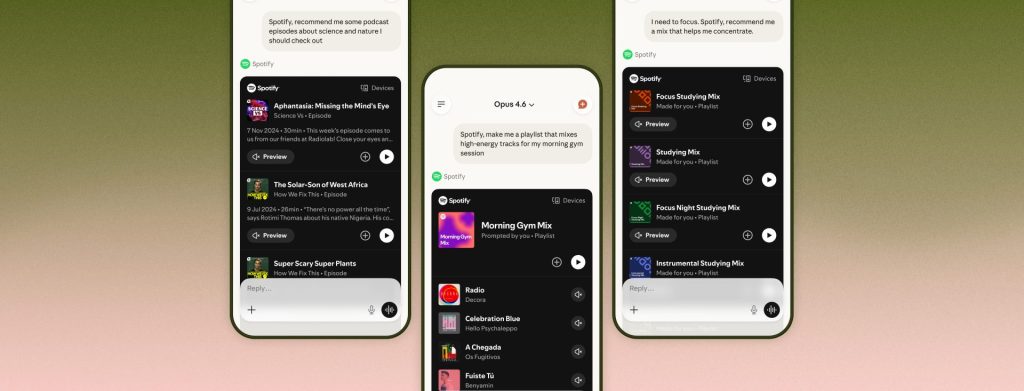
You can also ask Claude for podcast recommendations or generate playlists based on a particular genre, artist, or influencer. The possibilities are endless.
Claude uses your listening data and preferences to tailor responses to your tastes. This is essentially what Spotify already did, to some extent. However, integrating the two services allows them to go further, and the requests are formulated differently: they come from you.
For Anthropic and its AI, Claude, integrating third-party apps is not only a way to stand out from the competition but also to create synergies between services. While allowing users to access a multitude of services with just a few clicks, they can now use only one. Booking a hotel via Booking or ordering food via Uber Eats can now be done directly from Claude.
While ChatGPT offers similar features, are AIs definitely becoming centralized tools? And will streaming platforms follow the same path?
Spotify, Claude & AI: Are next-generation playlists here? The impact
With Claude, Spotify aims to shift its users from a passive to an active role. Whereas previously they consumed what Spotify suggested based on their listening habits, they can now influence these recommendations by shaping the platform’s choices through prompts and text elements.
This also illustrates how two Artificial Intelligences can coexist: both Spotify’s algorithm and Claude’s conversational intelligence. All of this is geared towards music recommendations that enhance the reach of playlists, those lists of songs that are increasingly popular among music lovers.
In terms of competition, Spotify is taking another step forward: for now, aside from Melon, a South Korean music streaming service, it is the only streaming platform to have forged such a strong partnership with an external AI.

This is a way to fully leverage these tools and enhance the user experience of its services. And to create a new entry point to Spotify via Claude for users who may not yet be subscribers. The Swedish platform is thus symbolically positioning itself as the ideal destination for anyone wanting to listen to music.
Especially since, in October 2025, Spotify had already made headlines by announcing an integration with ChatGPT. By now partnering with Claude, Spotify seems ready to cover all needs.
In a global context where Claude, Gemini, ChatGPT, and others are increasingly gaining ground at the expense of Google and other search engines, and even becoming the primary destination for many internet users when browsing or asking questions, Spotify’s dominance offers interesting growth opportunities. Could this lead to a point where playlist generation is done exclusively by AI? The process seems to be underway, and we could very well be witnessing another revolution in listening habits!
What about Soundiiz’s AI-playlists generator?
Let’s put it simply: Soundiiz didn’t wait for Spotify and Claude to allow users to generate playlists by entering prompts. Or tags.
Faced with the exponential rise of Artificial Intelligence, we couldn’t ignore the tool: at Soundiiz, we’re as passionate about technology as we are about music. And that’s why we launched our own AI tool, accessible directly here.
It’s a mix of existing AI and our own tools, designed as a serious alternative to other recommendation services on music streaming platforms. You can describe what you want to listen to and enter tags for moods, decades, musical genres, and more.

And that’s not all: once Soundiiz has generated the playlist, you can export it to the streaming platform of your choice, whether it’s Deezer, Spotify, Apple Music, Qobuz, TIDAL, YouTube Music, or Amazon Music. You can also ask Soundiiz to generate a new playlist as often as you like, based on criteria you’ve previously entered!
With Soundiiz’s AI playlist generator, it might seem like you don’t need Claude and Spotify, but… almost!