No one likes being forced to do anything. No one. Yet, in 2014, that is exactly what happened to Apple Music users, who found a new U2 album automatically added to their libraries—without having to lift a finger. It is a story that still sparks conversation, symbolizing a bygone era of music streaming and revealing much about the opportunities and pitfalls of the digital age. When U2 forced the world to listen to their new album: join us for the story!

Estimated reading time: 9 minutes
Key takeaways
- In 2014, U2 and Apple partnered to automatically add Songs of Innocence to the iTunes libraries of millions of users as a promotional move tied to the iPhone 6 launch.
- The forced U2 album release reached an estimated 500 million users, but triggered widespread backlash because people had not chosen to receive the album.
- The U2 album giveaway became a public relations disaster, raising concerns about unwanted content, the value of music, and how much control streaming platforms have over users’ libraries.
- Bono later apologized and took responsibility for the controversial promotion, which remains a defining example of the pitfalls of digital music marketing.
AI-generated summary
When U2 forced the world to listen to their new album: the context
In the early 2010s, U2 found themselves in a difficult spot. Their previous album, No Line on the Horizon, had been a commercial letdown; for one of the world’s most famous bands, the sales figures were disappointing.
They weren’t alone in this predicament: the music industry was at a historic turning point. Piracy was wreaking havoc, dragging labels and artists alike into a downward spiral.
U2 tried various approaches, toyed with concepts that were ultimately scrapped. They worked with a multitude of producers before teaming up with Danger Mouse for a new album they intended to call Songs of Innocence. Several entire albums were discarded before they reached the final result.

The band experimented, made mistakes, and started over, eventually arriving at a collection of songs they believed could live up to their past successes. They needed a hit; there was no room for error.
To boost their chances of success, they agreed to make concessions to the modern era. Music streaming—initially hailed as a lifeline following the launch of iTunes in 2003—was once again being presented as a savior.
A deep relationship
As it happened, Apple CEO Tim Cook was a fan of U2’s music. What’s more, he once described U2 as his favorite band. Never one to miss a business opportunity, Tim Cook—back in 2004, as U2 prepared to release a new album and needed to bounce back from the failure of their previous one—saw a chance to kill two birds with one stone.
The iPhone 6 was about to launch, and Apple was, naturally, positioning it as a minor revolution in mobile technology. And mobile technology goes hand in hand with music streaming. Music consumption was increasingly shifting to digital formats. After initially being reluctant to embrace digital listening—like many other artists—U2 realized that this was the future and that it would be unwise not to get on board.
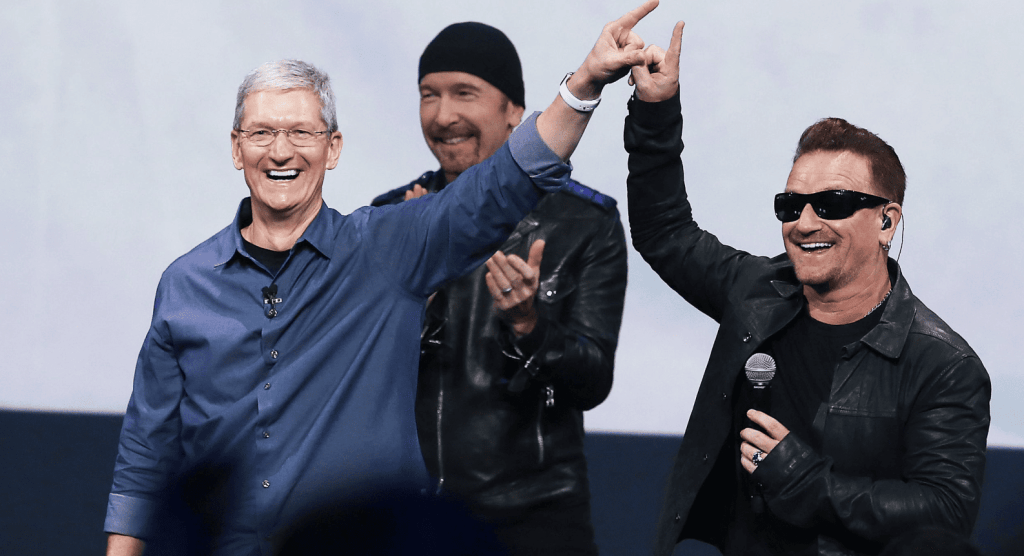
Tim Cook then proposed an idea. To demonstrate the iPhone’s ability to digitize everything and to give iTunes a significant boost, he thought it would be smart to tie the release of U2’s new album to the launch of the iPhone 6. The plan? Automatically upload the new record to the iTunes libraries of every user of the service—without them having to lift a finger.
It had never been done before.
But what might have seemed like an innovative concept turned out to be an absolute disaster—one that would haunt both U2 and Apple for years to come.
When U2 forced the world to listen to their new album: what really happened?
Picture this: you’re at home, relaxing. You get up and start scrolling through your streaming platform—just like any other day—looking for new releases or a playlist to soundtrack your morning. And then, a surprise.
You spot something that shouldn’t be there—or at least, something that isn’t part of anything you’ve liked, followed, or downloaded. An album by a band you don’t listen to, appearing as if by magic, without you ever having chosen it.
That is exactly what happened to millions of users in 2014 when U2’s album Songs of Innocence appeared in the iTunes libraries on their iPhones and iPods. It is estimated that a total of 500 million users—500 million, you read that right—saw the new U2 album pop up in their libraries. A staggering figure. And a promotional campaign of unprecedented scale. Tim Cook even went so far as to call it the “largest album release of all time.”

One internet user even joked on social media after spotting the album in their library: “Woke up this morning to find Bono in my kitchen, drinking my coffee, wearing my dressing gown, reading my paper.”
Another chimed in: “Apple owes me a new iPhone, because I had to purify this one with fire after finding a U2 album on it.”
Rapper Tyler, The Creator felt much the same way. He stated that seeing the album on his iPhone was “like waking up with a pimple or like herpes… Fuck Bono. I didn’t ask for you, I’m mad.”
Bad idea!
The U2 album was uploaded on September 9, 2014, while the band was performing at the iPhone 6 launch event. The idea seemed sound, especially since the album was being offered to iTunes users for free. Tim Cook and U2 were confident in the move’s benefits: how could anyone turn down a free album? Surely, everyone would be happy.
For U2, giving away the album without financial return wasn’t an issue. It was intended to serve as a promotional tool for their upcoming world tour, which was expected to generate millions of dollars. Bono, the band’s frontman, also viewed it as a first step toward an exclusive subscription model where fans could enjoy special perks.

For Apple, partnering with one of the world’s most famous bands was a powerful marketing move. And proof that the company remained at the forefront of trends. However, reports suggest that Tim Cook was initially reluctant. The very purpose of iTunes had been to combat piracy and place value on music. Not to give it away for free. Yet, he was eventually persuaded.
But what promised to be a joint success for the band and the tech giant turned out to be a major debacle.
The kind that lingers in people’s memories for years and forces those involved to offer profuse apologies.
When U2 forced the world to listen to their new album: the consequences
The consequences? A public relations disaster, for starters. Countless people were offended to see an album they would have never have listened to appear in their iTunes libraries. To many, it felt like an invasion. It also raised questions about the music streaming model.
Have we become passive in our listening habits? Are we at the mercy of the streaming platforms we choose to use? If Apple can force an album into my music library, where do they draw the line? Just how far can companies go?
Following the release, fans and the media were up in arms. Established artists felt the move devalued music. The trend of free content—increasingly common since the advent of streaming—was seen by some as a step in the wrong direction, implying that certain works have no inherent value. And if some things are free, why pay for others?

Newspapers like the Washington Post described the operation as “dystopian junk mail”. A sign of new technologies leading to uncontrollable excesses. Wired called it “worse than spam”—and that was just the tip of the iceberg.
Because there was another problem: the album was difficult to delete from libraries. It was stored in the cloud by default, making it nearly impossible to get rid of. Even if you deleted the songs one by one. iTunes users grew frustrated and impatient. So much so that Apple was forced to launch a dedicated website explaining how to remove it.
The internet erupted, flooded with mockery and annoyed comments. Someone even created a Tumblr page titled “Who is U2 and why is it on my phone??!”. The backlash was total. And the operation proved to be a fiasco—not just for Apple, but for U2 as well.
Bono apologizes
Beyond that aspect, the quality of the album was also called into question. Many fans reacted negatively to this new U2 record. For some, it was further proof of the gradual decline of a group that had shown flashes of brilliance in the past. As of 2026, Songs of Innocence remains a mixed entry in U2’s vast discography.

In his 2022 memoir, Bono even apologized, stating that he alone was responsible for the affair. It was an admission of weakness—eight years later—and a symbol of the disaster that was this “forced” release:
“I take full responsibility. Not Guy O, not Edge, not Adam, not Larry, not Tim Cook, not Eddy Cue. I’d thought if we could just put our music within reach of people, they might choose to reach out toward it. Not quite. As one social media wisecracker put it, ‘Woke up this morning to find Bono in my kitchen, drinking my coffee, wearing my dressing gown, reading my paper.’ Or, less kind, ‘The free U2 album is overpriced.’ Mea culpa.”
During a Facebook Live session, Bono went even further: he admitted the operation was megalomaniacal. He apologized to a user who felt it was rude to impose their music in such a way.

He described the whole thing as:
“A drop of megalomania, a touch of generosity, a dash of self-promotion and deep fear that these songs that we poured our life into over the last few years mightn’t be heard.”
Is a confessed fault half-forgiven? While none of this is exactly earth-shattering, this type of promotion will certainly never be repeated. At the very least, this partnership between Apple and a music group has served to highlight the problematic practices within the music streaming world.
It serves as a reminder that we—as paying subscribers to these platforms—do not have total control over the music we want to listen to.