In its twenty-year history, the world of music streaming has undergone countless changes—and spawned just as many incredible stories and anecdotes. Take, for instance, those totally unknown, mysterious figures who manage to rack up billions of streams… without anyone ever knowing their names. Meet Johan Röhr: the artist with billions of streams nobody knows.

Estimated reading time: 9 minutes
Key takeaways
- Johan Röhr, a Swedish composer, generated more than 15 billion Spotify streams by releasing around 2,700 ambient and instrumental tracks under roughly 650 different artist names.
- His success is largely tied to the rise of mood music playlists, with piano-based focus, relaxation, and study tracks earning hundreds of millions of streams through Spotify’s highly popular curated playlists.
- The Johan Röhr case sparked debate about Spotify royalties, playlist placement, and whether streaming platforms disproportionately reward anonymous mood music creators at the expense of other artists.
- The controversy also highlights growing concerns about AI-generated music, as mood playlists are increasingly vulnerable to automated content that can compete with human-made ambient music for streams and revenue.
AI-generated summary
The artist with billions of streams nobody knows – Who is Johan Röhr?
No more than three lines on his Wikipedia page. No interviews, no media appearances. A few photos on Google Images, but not much else. Johan Röhr seems like a ghost. In the age of the internet and constant media exposure, that is quite surprising. Especially considering just how many times his songs have been played.
The only thing we know for sure? Johan Röhr is Swedish. No date of birth, no biography explaining his background or where he comes from: nothing but his country of origin. And the certainty that Johan Röhr isn’t the only name he uses to release his music. Far from it.

It all began in 2024, when the Swedish outlet Dagens Nyheter published an article titled “The secret composer behind hundreds of artist names.”
Curiosity grew; the article and the publication attracted increasing attention, and the story was picked up worldwide. The Guardian, Le Monde, and others—the internet went wild. It all seemed too big to be true. The details in the article seemed unreal, with figures that appeared impossibly inflated. Johan Röhr had reportedly amassed more streams than ABBA, Elton John, Metallica or Michael Jackson—some of the most famous artists and groups on the planet.
Mystery still intact
Yet the man remains a mystery. Well, not exactly. Can someone truly be mysterious if they have released around 2,700 songs on Spotify—garnering over 15 billion streams—under a staggering 650 different names? You read that right: 650 different names. And yet, there is only one person behind them all: Johan Röhr, the most famous unknown person on the planet.

The newspaper Dagens Nyheter reveals that Johan was born in September 1976 in Täby, a town north of Stockholm. It also notes that he composed a few songs for Swedish pop stars under his own name, toured, and worked for Swedish television; after that, not much.
Or rather, an explosion. But an anonymous one.
The artist with billions of streams nobody knows – Hundreds of fake names
Johan is a bit of a genius. Or at least, a man who figured out how to play the music streaming game—and where to position himself to rake in the maximum number of streams. Maya Åström, Minik Knudsen, Mingmei Hsueh, Csizmazia Etel… These are just four of the hundreds of names Johan has used to release instrumental tracks on Spotify. After weeks of cross-referencing data, an investigation by the newspaper Dagens Nyheter revealed that every one of these pseudonyms belonged to the very same person. But why do it?
The explanations are vague. Mysterious—just like Johan. Diluting his identity across near-anonymous profiles allows him to stay out of the spotlight, to keep operating under the radar without attracting attention. Because that isn’t what Johan is trying to do: he has no desire to be a household name or to run an Instagram page followed by millions. What he wants—and what he has achieved—is to be everywhere, all the time.

He aims to multiply his entry points to rack up streams. Johan is a visionary; he realized before anyone else just how popular ambient music would become.
These are the tracks often described as “background noise”. Music people play on loop to focus or relax, whether at work or at home. Minimalist melodies, often built around piano loops, have garnered millions of streams on Spotify and have become a true pillar of the streaming landscape.
Silence
When asked about the Johan Röhr case by The Guardian, a Spotify representative replied:
“There is an increased interest in functional music created to enhance everyday activities such as relaxation, focus, or studying, and these playlists are created to match the listeners’ demand. This type of music typically exists in Spotify’s Focus hub, which limits competition with artists from traditional genres of popular music.”

Johan refused to speak to journalists, but a representative from his label, Overtone Studios, agreed to talk with The Guardian. Describing Johan as a “pioneer in the mood music genre,” he added:
“Röhr published music across many different artist profiles and became a pioneer in the mood music space, which is hugely popular today. Many of these are now historical, inactive musical projects, and we have already significantly reduced the number of artist profiles actively publishing music.”
There is something else behind Johan’s extraordinary story. Something more insidious—and perhaps problematic.
The artist with billions of streams nobody knows – Is Spotify guilty?
Following the publication of the investigation, accusations have poured in: Jonah allegedly benefited from an arrangement between Spotify and artists that allowed them to secure prime placement on popular playlists in exchange for lower per-stream payouts. Up to four times lower—practically nothing—but when multiplied by millions, the figures become lucrative.
For Spotify, the goal is to capitalize on the popularity of mood music and provide users with exactly what they are looking for, in large quantities. For the artists involved, this represents a source of supplemental income—or even a full-time career. According to experts, the hundreds of aliases Jonah uses may well be a roundabout way of complying with this arrangement.

The highly popular Spotify playlist “Stress Relief” which boasts nearly 2 million followers, features 41 tracks linked to Jonah out of a total of 270 (as of 2024). His most-streamed song, “Twinkle Twinkle, Little Star,” has been played over three hundred million times. You can imagine the scale of those streaming numbers.
The figures here are also murky; it is difficult to determine exactly how much Jonah has earned across all his pseudonyms. A study by his label suggests he amassed nearly 3 million euros in royalties in 2022—a lucrative business.
The artist with billions of streams nobody knows – A well-rounded business
But that’s not all. The investigation reveals that Jonah isn’t the only one involved. In fact, around a hundred other Swedish artists have reportedly jumped on the bandwagon. The “Peaceful Piano” playlist—one of Spotify’s most popular in the mood music category—is said to be dominated by songs composed by mysterious Swedish artists (other than Jonah himself). A national pastime?
Beyond this specific scheme, the entire streaming system itself is being called into question and criticized. For many musicians, ambient music represents a significant source of income. They view this as their livelihood—one dominated by a handful of artists who capture the lion’s share of the revenue. Are Spotify and other platforms being dishonest when they claim to protect artists’ rights and exist, in part, to help them build their careers?

Placing the blame entirely on Spotify would be a mistake, given the difficulty of restricting the uploading of every single song. However, greater regulation is certainly needed, as is a reduction in the concentration of power in the hands of a single entity. Without safeguards, artists whose profession involves creating instrumental tracks for “mood playlists” face a threat—especially since another very real danger is currently upending the entire landscape.
The AI Problem
In 2024, AI-generated songs did not yet pose the threat they do today. We are discussing this here for a simple reason: mood playlists are particularly vulnerable to the proliferation of artificial intelligence.
In recent months, hundreds of artificially generated songs have appeared on popular mood playlists, depriving “real artists” of streams they previously took for granted.

An investigation by Liz Pelly for Harper’s Magazine, titled “The Ghost in the Machine,” even accused Spotify of artificially padding its playlists with AI-generated tracks to reduce royalty payouts.
In many respects, the “Jonah” case appears linked to AI. Flooding the market under hundreds of different pseudonyms resembles a tactic employed by bots seeking to dominate the sector. That does not appear to have been the case, and Jonah certainly seems to be a genuine artist, yet it is impossible not to draw a parallel between this story and more contemporary concerns.
What about Soundiiz?
Since our inception, Soundiiz’s priority has been to provide music enthusiasts with the best tools to optimize their daily streaming experience. This involves, among other things, making it easy to transfer data between platforms, back up playlists, view data in a single interface, and create SmartLinks.
We also wanted to ensure that users of Deezer, Apple Music, YouTube Music, Tidal, Qobuz, or Amazon Music could enjoy playlists from a platform like Spotify—without actually having a Spotify subscription.
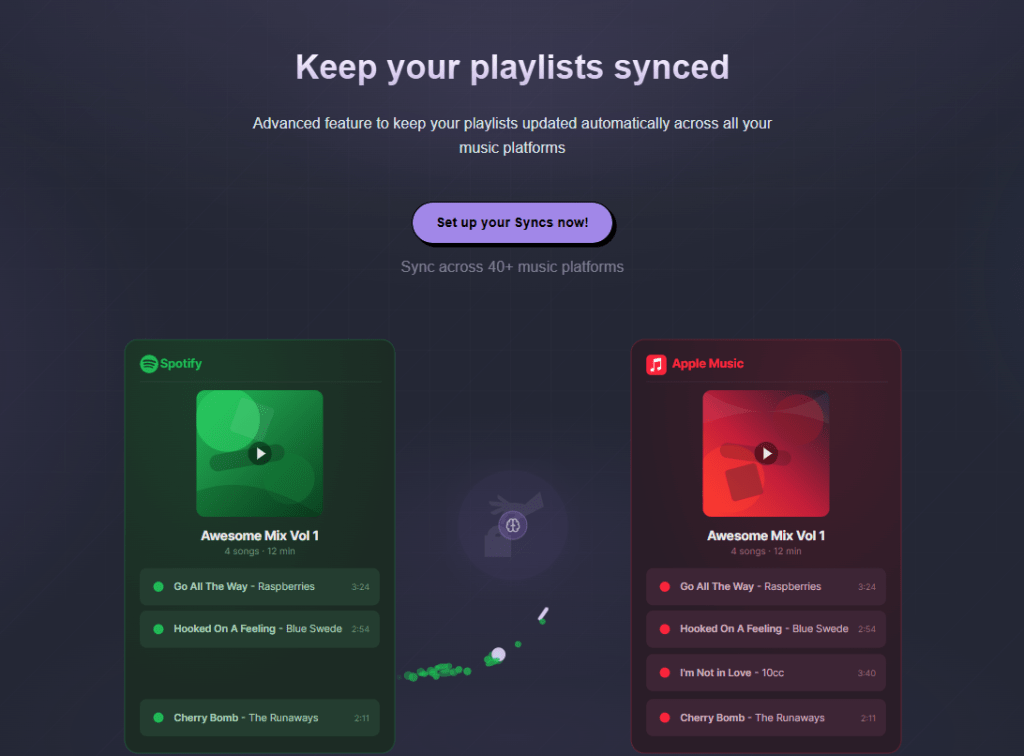
We also know that Spotify’s “mood” playlists—which we discuss in detail in this article—are incredibly popular. That’s where our synchronization tool comes in! Once you’ve set up your Soundiiz account, you can listen to any Spotify playlist you like on your preferred streaming service.
There’s no risk of losing anything! With Soundiiz, you can enjoy the best of all worlds. Click here to try out our services.