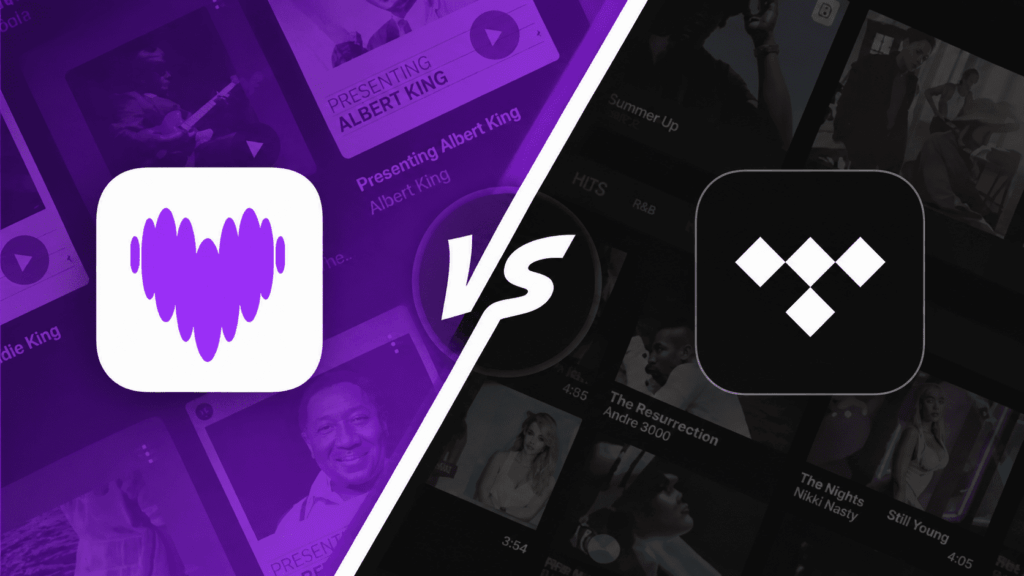
Choosing between Deezer and TIDAL goes beyond comparing their music catalogs and features. There’s more to consider: playlists and algorithms, podcasts and audiobooks, pricing, user experience, and audio quality. While they both offer high-quality audio and personalized recommendations, they target slightly different types of listeners. Deezer is the better all-round choice for most users, thanks to its podcasts, flexible plans, and broader feature set. TIDAL is the better choice for audiophiles and music-focused listeners, thanks to its Hi-Res FLAC audio and Dolby Atmos support. But let’s not get too ahead of ourselves: Deezer vs. TIDAL: Which Music Streaming Service Is Best in 2026?
- Playlists and algorithms
- Catalogs
- Podcasts & audiobooks
- Price & subscription
- User experience
- Audio quality
- Our choice!
Let’s take a look!
Estimated reading time: 15 minutes
Note: We compared Deezer and TIDAL using our experience with the platforms, user reviews, and across six criteria: recommendation features, catalog, podcasts and audiobooks, pricing, user experience, and audio quality. This analysis was conducted in September 2026; prices and features may vary depending on when you read it. Please check the platforms’ websites before deciding.
Key takeaways
- Deezer is the best overall music streaming service for most users in 2026, thanks to its strong music discovery features, podcasts, flexible subscriptions, and broad feature set.
- TIDAL is the better choice for audiophiles and music-focused listeners, offering a larger catalog, Hi-Res FLAC audio up to 24-bit/192 kHz, and Dolby Atmos support.
- Deezer has the advantage for podcasts, music discovery, and subscription flexibility, while TIDAL offers a cleaner music-focused experience and better options for DJs.
- The choice between Deezer and TIDAL ultimately depends on your priorities: choose Deezer for an all-in-one listening experience, or TIDAL for superior audio quality and a larger music catalog.
AI-generated summary
Deezer VS TIDAL: Quick answer
| Best for… | Choose |
| Playlists and algorithms | Deezer |
| Catalogs | TIDAL |
| Podcasts & audiobooks | Deezer |
| Price & subscription | Deezer |
| User experience | TIDAL |
| Audio quality | TIDAL |
| Best overall | Deezer |
Overall winner: Deezer for the most listeners, thanks to its podcasts and countless features. TIDAL is the better choice for audiophiles and listeners who prioritize audio quality above everything else.
Deezer VS TIDAL: Playlists and recommendation algorithms
TIDAL offers an effective blend of discovery and recommendations tailored to user tastes through features like “My Mix,” “My Daily Discovery,” and radio stations.
A notable highlight is that its recommendations combine AI-driven algorithmic content with human curation. Its playlists—particularly “My Mix,” which is based on your listening habits—should deliver exactly what you’re looking for.
Meanwhile, “Daily Discovery” is updated daily with new tracks based on your recent listening history. This approach keeps recommendations fresh without sacrificing the human touch that TIDAL values.
TIDAL recognizes that while users need recommendations based on their usual listening habits, they also appreciate expert-curated suggestions.
Deezer’s algorithm
Deezer offers an experience similar to TIDAL‘s, blending recommendations based on individual listening habits with previously unknown songs and artists, allowing users to explore the richness of the music industry.
Deezer’s “Flow” system has long been acclaimed for the quality of its recommendations. This is especially true given a highly interesting feature added in April 2025: users can now actively influence their recommendations.
By telling Deezer that a specific song or artist should no longer appear in their playlists, users can directly shape the quality and nuance of the suggestions they receive. With Deezer, users take control of the algorithm rather than remaining passive recipients; they become active participants in their own musical discovery. In our testing, this makes it easier to refine recommendations over time. In addition to Flow, editorial playlists curated by Deezer-selected experts across every genre bring back the human touch we also appreciate in TIDAL.
Throw in Daily Mixes, playlists based on specific songs, and a wide array of other features, and you get a platform with an algorithm that is not only effective but also branches out in many different directions to satisfy the broadest possible audience.
Thanks to its diverse offerings, its ability to influence recommendations, its editorial playlists, and its ideal blend of discoveries and familiar tracks, Deezer seems to have a slight edge over TIDAL in our view.
Winner: Deezer ✅
Deezer VS TIDAL: Music catalogs
Based on what their website says, TIDAL offers around 180 million music tracks, while Deezer offers “only” 120 million. That’s a difference of 60 million—which might seem huge, but in reality, it isn’t all that critical. Most users will be perfectly happy with 120 million tracks.
But who knows! That obscure 1960s Icelandic folk album might be available only on TIDAL, not on Deezer! In that case, the difference could prove decisive.

Deezer publishes clear content limits: you can add up to 5,000 songs to each playlist and up to 10,000 to your Favorites. TIDAL does not currently publish an equivalent overall limit in its support documentation, so these caps should not be a deciding factor unless you maintain very large playlists or collections.
For an endless, larger catalog, choose TIDAL.
Note: TIDAL claims the larger catalog, but its size alone doesn’t always determine which service has the music you want to hear. Availability can vary by country, rights agreements, and individual releases.
Winner: TIDAL ✅
Deezer VS TIDAL: Podcasts & audiobooks
The biggest difference between TIDAL and Deezer is their approach to podcasts and audiobooks—two distinct philosophies on supplementary content.
TIDAL made a simple choice: to keep music at the center. It does offer music videos, original shows, and some podcasts, but not the broad podcast and audiobook catalog you get on Deezer. Music comes first. It is a bold decision that sends a clear message—TIDAL is a platform for audiophiles and music enthusiasts.

The result is an uncluttered music experience and a service that focuses on what it does best. However, while this choice is understandable, it may deter some users, given that podcasts and audiobooks have become an essential part of our listening habits.
That is why Deezer decided not to choose at all, offering a wealth of podcasts within its app. While audiobooks still have room for improvement—though a few titles are available—Deezer offers an all-in-one experience designed to meet everyone’s needs. A few rare podcasts aren’t available on Deezer, but overall, the selection is excellent.
There is no debate here: if you are a big fan of podcasts, don’t hesitate for a second—choose Deezer.
Winner: Deezer ✅
Deezer VS TIDAL: Price & subscription
In September 2026, for a TIDAL subscription, the costs are:
• $11.99 per month for an individual subscription
• $19.99 per month for a family subscription, for up to 6 members
• $6.99 per month for a student subscription
• $19.99 / month for a DJ subscription, which will allow you to integrate TIDAL with supported DJ software and hardware.

In September 2026, for a Deezer subscription plan, the costs are:
• $11.99 per month for an individual subscription
• $15.99 per month for a Duo subscription
• $19.99 per month for a family subscription
Looking at these figures, the conclusion is clear: Deezer is the most logical choice if you want a more flexible subscription plan—since TIDAL doesn’t offer a Duo option—without paying a penny more.
However, TIDAL is an attractive option for DJs. DJs use TIDAL for their sets because of the platform’s audio quality and compatibility with various mixing software. In this rare scenario, TIDAL is a solid choice. But for most people, Deezer is likely the better fit.
Choose Deezer for flexibility; choose TIDAL if you’re a DJ.
Winner: Deezer✅
Deezer VS TIDAL: User experience
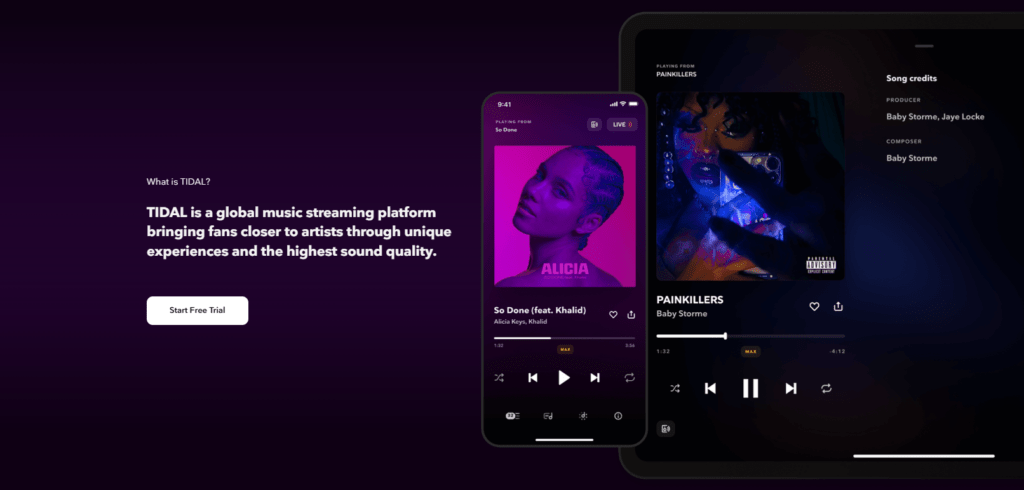
Let’s be honest: this category is relatively subjective. Your user experience will depend on your profile and what you expect from your streaming platform. If you want a clean, efficient, music-focused interface, choose TIDAL. With its elegant design and seamless connectivity to other devices via TIDAL Connect, TIDAL offers a balanced experience for anyone who prioritizes music above all else.
On the other hand, if you want a music streaming platform that highlights supplementary content to enrich the listening experience, Deezer might be a good option. Features like “SongCatcher” (which easily identifies songs, much like Shazam), in-app “Blind Test” games, and “Shaker” (which mixes the tastes of different user profiles to create a playlist) are cool additions to the core music experience—though some might dismiss them as gimmicks!
At Soundiiz, we appreciate TIDAL’s clean, efficient approach. Choose TIDAL for simplicity, or Deezer for features beyond the music.
Winner: TIDAL ✅
Deezer VS TIDAL: Audio quality
In this category, there is no debate. Since its high-profile relaunch in 2015, TIDAL has made audio quality a top priority—and a compelling selling point against its competitors. TIDAL has long positioned itself as an artist-first platform. And “artist-driven” implies optimal audio quality—exactly, or very close to, what is recorded in the studio.
Alongside Qobuz, TIDAL has become the go-to platform for audiophiles over the years. TIDAL is one of the strongest options for high-resolution streaming, offering Hi-Res FLAC up to 24-bit/192 kHz. If you aren’t sure what that means, simply put: it’s hard to find audio quality this good.
That’s not to mention Dolby Atmos. This feature lets you listen to music in “three dimensions” for a fully immersive experience.
That doesn’t mean Deezer offers a poor-quality experience—far from it. In fact, its 16-bit/44.1 kHz FLAC format will satisfy most audiophiles. We certainly wouldn’t want to portray Deezer as a service that skimps on the quality of the music it streams; honestly, it is one of the best-equipped platforms in this regard. But the numbers don’t lie: TIDAL comes out on top for resolution.
A word of caution, however: top-tier audio resolution won’t do you much good if you don’t have high-quality speakers or headphones. Even the best audio quality will sound average on mediocre headphones. You may need to make a small investment to enjoy what TIDAL offers fully.
Note: If you decide to upgrade your listening gear, make sure it supports Dolby Atmos technology for a truly immersive experience.
For audio quality that is virtually unmatched—save for Qobuz—choose TIDAL.
Winner: TIDAL ✅
A bit of history
Okay, we know many of you didn’t come here to read the history of TIDAL and Deezer—you want to jump to the conclusion (which, conveniently, is right below)—so we’ll keep it brief! Old habits die hard: at Soundiiz, we LOVE telling the stories behind streaming platforms. Understanding where they come from often helps us understand where they stand now and where they might be headed.
It’s a little-known fact, but Deezer is one of the oldest streaming platforms around. Deezer launched in 2007—even before Spotify! TIDAL launched in 2014, then made headlines the following year with a high-profile relaunch featuring music stars like Jay-Z.

This makes sense, given that TIDAL positioned itself from the start as a platform created by artists, for artists. More than a decade later, that DNA remains unchanged. Although figures are hard to pin down—depending on factors like the users’ geographic location—TIDAL remains one of the services that pays artists the most per stream today.
This is a significant sign of its commitment to a fairer streaming system.
A different path
Deezer is following a similar path but is focusing on different areas of the music industry. The French-founded company has undergone many changes, but since the early 2020s, it has clearly signaled its international ambitions—and backed them with action.
One of its key priorities is tackling the proliferation of AI in the music industry and shifting toward a fairer, more equitable artist payment system, in partnership with major international labels.

Known as the “artist-centric” model, this approach aims to rethink how artists receive revenue from their music. You can learn more about the artist-centric model right here. In short, while TIDAL and Deezer have very different trajectories and—as we have seen in this article—offer distinct features, both are committed to championing artists and creators and aim to shift mindsets.
Whichever one you choose, you can’t go wrong!
Deezer vs TIDAL: which is better for you?
Enough talk—here is our summary table!
We compared Deezer and TIDAL across six criteria: playlists and algorithms, catalog size, non-music content, subscription flexibility, user experience, and audio quality. We even rated the two services!
| Categories | Which is best | Why? | Score |
| Playlists and algorithms | Deezer | Deezer has more features and you can act on your music recommendations | Deezer: 8.5/10 TIDAL: 8/10 |
| Catalogs | TIDAL | More songs in TIDAL’s catalog | Deezer: 9/10 TIDAL: 10/10 |
| Podcasts & audiobooks | Deezer | A much broader podcast selection on Deezer | Deezer: 8.5/10 TIDAL: 1/10 |
| Price & subscription | Deezer | More flexibility on Deezer | Deezer: 8.5/10 TIDAL: 8/10 |
| User experience | TIDAL | TIDAL is more sober and efficient, as it keeps music at the center | Deezer: 8/10 TIDAL: 9/10 |
| Audio quality | TIDAL | Top-notch audio quality from TIDAL | Deezer: 8/10 TIDAL: 10/10 |
As the summary shows, TIDAL and Deezer are neck and neck. This makes sense: both platforms offer everything a music lover could want from a streaming service—good (or even excellent, in TIDAL’s case) audio quality, a wealth of features, robust algorithms, and market-competitive pricing.
However, if you have carefully reviewed each of the categories analyzed, you will notice that the two platforms differ on one crucial point—one that could sway users one way or the other: non-music content. In this regard, Deezer is the clear winner, offering a podcast selection that TIDAL cannot match.
But if you want nothing but music, the choice becomes relatively straightforward: choose TIDAL; its audio quality is superior—provided you have good headphones or speakers—and its catalog is more extensive.
On the other hand, if you want an all-in-one experience that brings everything together—podcasts and music alike—then Deezer is the better choice.
Choose Deezer if:
- You listen to a lot of podcasts
- You live in France and can take advantage of subscription bundles with other services
- You want to enjoy a wide range of features
- You want to support a streaming platform that is taking a stand against AI and evolving its artist payment system (the “artist-centric model”)
- You want an all-in-one service that combines music with related content
Choose TIDAL if:
- You want one of the best options for high-resolution streaming and a Dolby Atmos option to hear your music as if you were in the studio
- You want a platform that is clean, efficient, and elegant
- You want a service that keeps music at the center
- You care about how artists are paid on music streaming platforms
- You want a massive song catalog
Deezer VS TIDAL: Which Music Streaming Service Is Best in 2026?
Which is better for audiophiles? TIDAL.
Which is better for podcasts? Deezer.
Which is better for music discovery? Deezer
Which is better for DJs? TIDAL
Which is better for most users? Deezer.
Simple, right?
Transfer your data from Deezer to TIDAL, and from TIDAL to Deezer.
Thinking of switching from Deezer to TIDAL? You don’t have to rebuild your music library from zero. Soundiiz can transfer your playlists, favorite tracks, albums, and artists from Deezer to TIDAL. With the Soundiiz Transfer tool, you no longer have to wonder how to move your data from Deezer to TIDAL or from TIDAL to Deezer. Everything is transferable—your playlists, artists, albums, and liked tracks—in just a few minutes.
Our Transfer tool creates a near-perfect mirror of your Deezer or TIDAL account on your destination platform (though rare matching errors can occur if metadata differs between Deezer and TIDAL).
This comes from years of refining our tools to keep them as accurate and user-friendly as possible. The good news is that we offer a free version of our services so everyone can enjoy what we have to offer.
Soundiiz Free never expires and lets users transfer as many playlists as they want, one at a time. A source playlist can contain more than 200 tracks; users can select up to 200 tracks for a free transfer. The first 200 tracks are selected by default, but you can adjust the selection before starting. This limit applies to each playlist individually, rather than as a cumulative account-wide quota.
If you want to transfer more data, you can subscribe to one of our no-commitment plans—meaning a one-off transfer is an option—right here!
And to explore everything Soundiiz has to offer—pssst, we do FAR more than just playlist transfers—head over here!