Is Spotify still worth it in 2026? Spotify, the market leader, remains, without a doubt, one of the most complete music streaming services in 2026. This is especially true for music discovery, personalized recommendations, podcasts, and the overall music experience. However, questions surrounding artist remuneration, AI-generated music, and the complexity of its interface may make alternatives more attractive for some listeners. Spotify Review 2026: Is Spotify Still Worth It? What do we think about this music streaming service, and is it really the one you need?
Our Spotify review in 2026: how we conducted our analysis
We evaluated Spotify across several criteria: price, artist remuneration, podcasts and audiobooks, algorithm, user experience, catalog, and audio quality.
Last tested: September 2026
Platforms: Web / iOS / Android / Desktop
Estimated reading time: 14 minutes
Spotify’s Pros and Cons
| Pros | Cons |
| Algorithm | Audiobook availability varies by market |
| Lots of podcasts and audiobooks | A bit crowded interface |
| New features and improvements | Artist remuneration remains controversial |
| Excellent cross-device experience | Not enough barriers to AI music |
| Large ecosystem of third-party integrations | Subscription prices often rise |
| Spotify Connect | Less emphasis on human editorial curation |
| An ever-growing catalog, with videos | |
| Social features | |
| Music discovery |
How much does Spotify cost in 2026?
Even though Spotify has regularly raised its subscription prices over the past few months—and faced significant criticism for doing so—it is worth noting that many competitors have done the same thing. The result? A few extra dollars on your monthly bill.
In September 2026, for a Spotify subscription, the costs are:
• $12.99 per month for an individual subscription
• $18.99 per month for a Duo subscription
• $21.99 per month for a family subscription
• $6.99 per month for a student subscription
Prices may vary depending on where you live, and when you read this review. Please check Spotify’s website to be 100% sure the figures are right.
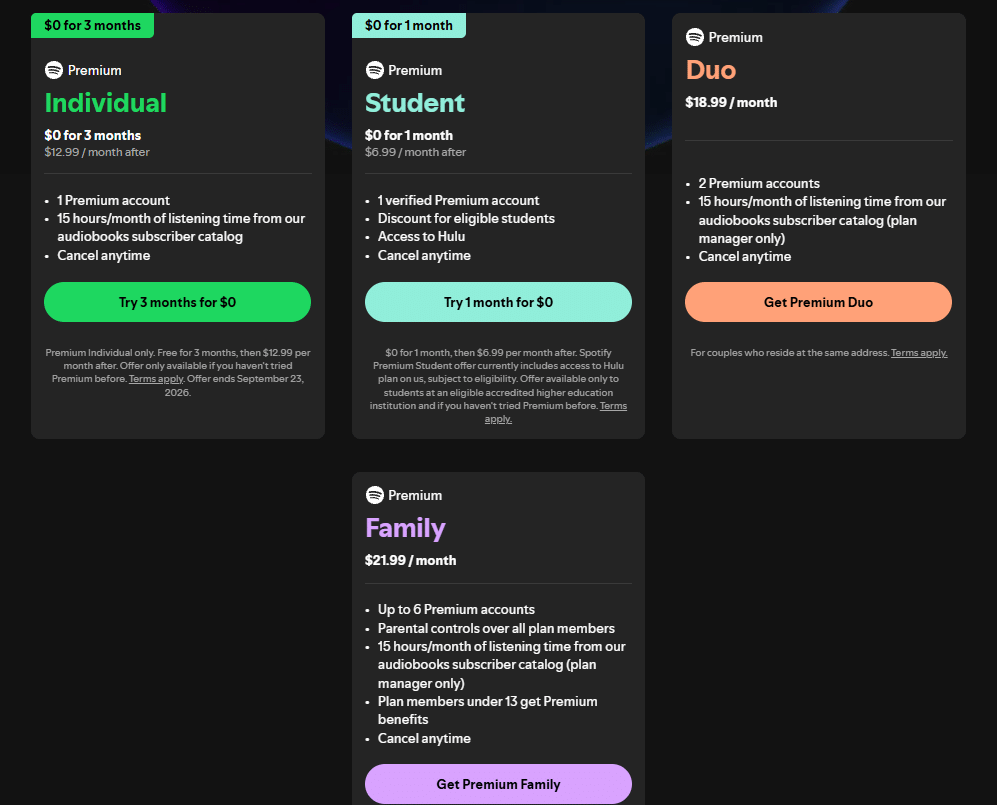
Spotify offers some of the highest subscription prices on the market. With plans ranging from Individual and Duo to Family and Student, a monthly individual subscription currently costs more than those from YouTube Music, TIDAL, Amazon Music, Apple Music, or Deezer. The difference isn’t huge—just a few cents or perhaps a dollar.
This is especially true given that platforms like YouTube Music and Amazon Music now offer subscriptions bundled with other Google or Amazon services. Their monthly prices are unbeatable, and for the moment, Spotify cannot match them.
If you are looking for a low-cost platform and price is your only priority, Spotify may not be the right choice.
How much does Spotify pay artists?
This has been a major topic of discussion in recent years. Music streaming has revolutionized not only how we listen to music but also the music industry as a whole. Between the slow decline of physical media and the shift to an all-digital landscape, artists have seen their earnings from their work change drastically.
As streaming has become the dominant way people consume music, the compensation platforms offer based on stream counts is crucial. Particularly for Spotify, the most widely used platform and, by extension, the one that generates the highest listen volume.
Spotify does not publish a fixed per-stream rate. But according to several specialized sites, Spotify—along with YouTube Music—is among the platforms that pay artists the least, with rates estimated at $0.003- $0.004 per stream, according to Ditto Music in June 2026. These are estimates, not official figures. Artists’ remuneration depends on several factors, and it is almost impossible to know exactly where the truth lies. To understand how royalties work, Spotify wrote a detailed guide.

In 2026, Qobuz made a bold move by revealing its remuneration policy. According to this article, they pay artists US$0.01873 per stream—a far cry from Spotify’s estimated $0.003.
A word of caution, however: apart from Qobuz, no platform discloses this remuneration data transparently. The figures vary by source, so take them with a grain of salt.
Artists’ remuneration is the primary reason Spotify faces heavy criticism and scrutiny from those who believe it is destroying the market and undermining artists’ standing in an already highly precarious socio-economic landscape.
What determines Spotify royalties?
- listener’s country
- subscription type
- total number of streams
- rights ownership
- agreements between artists, labels and distributors
Is Spotify’s catalog better than other streaming services?
By 2026, simply boasting about offering users hundreds of millions of songs is no longer enough. All platforms now offer more or less similar catalogs, at least when it comes to the most well-known tracks. While YouTube Music remains the clear leader—since it includes everything on YouTube—Spotify should still offer whatever you are looking for.
In 2026, services need to go further, offering more than just albums—specifically, supplementary audio content like podcasts or audiobooks. Spotify has certainly grasped this.
The Swedish platform has brought everything together in one place, and in vast quantities. This is simply because it was the first to invest heavily in this type of audio content. And it is now a worldwide phenomenon.
Competitors like Apple Music chose to offer such content via separate apps, while Deezer opted out of audiobooks entirely.
Neither TIDAL nor Qobuz offers podcasts; except Amazon Music—which also houses everything in one place—Spotify remains one of the best solutions for users who want all their listening in a single app.
However, there is a catch: today, a vast catalog inevitably brings artificial intelligence into the mix. On this front, Spotify is currently struggling to stem the tide of fake artists and songs uploaded to its servers every day. Then again, do they really want to stop it? Spotify is rolling out initiatives like verification badges for artists.
But without a stricter policy—implemented quickly—Spotify risks becoming a service overrun by AI… much like many of its competitors!
Is Spotify’s user experience efficient?
User experience is perhaps one area where Spotify could improve. Its interface—even after being modified a few months ago to adopt the “infinite scroll” style popularized by TikTok—remains opaque and cluttered.
It is overloaded with information, which tends to overwhelm navigation. While this isn’t an insurmountable hurdle after hours of use, it invites comparison with a competitor: Apple Music.

Apple has opted for a streamlined home page and navigation system where everything feels in the right place and the path forward is clearly marked.
Spotify seems to have taken the opposite approach, highlighting the vast array of options available to users. This is also part of the service’s appeal: the feeling that Spotify offers everything a music streaming service possibly could—and then some.
Is Spotify’s interface too cluttered?
The abundance of options results in information overload, which may deter some users. For instance, they recently changed how they showcase new releases from artists you follow by integrating them directly into the “Music” tab, yet without clearly highlighting that specific section.
Similarly, with a mix of personalized radio stations, recommended albums, daily picks, algorithmic playlists, listening suggestions based on recent history, mixes, and other features, users might feel lost in an endless stream of information.
The “Podcasts” tab is a prime example. Spotify offers hundreds of thousands of podcasts and presents a mix of recommendations and contextual highlights on this page, featuring eye-catching colors and shapes, poorly defined sections, and other elements that tend to clutter the visual field.
Opting for a clearer categorization system—one less packed with a chaotic variety of information—could improve the user experience. On the plus side, Spotify has finally made the categorization of releases on each artist page clearer.
You can now sort releases by format: Singles & EPs, compilations, collaborations, or albums. This improves navigation and highlights distinct content types more effectively.
Is Spotify’s algorithm good?
Short answer: yes, absolutely. Spotify is widely regarded as one of the strongest music discovery platforms by many experts and users. It helps you discover the artists that best match your tastes. The reason? Years of massive investment and a special focus on recommendation playlists.
These playlists are a key reason why so many people choose Spotify. They are widely acclaimed for their accuracy and their potential for music discovery.
However, there are some downsides. Spotify lacks human curation—unlike services such as Apple Music, Deezer, or Qobuz, which rely on experts to hand-pick artists and albums to recommend or include in playlists. At Soundiiz, we especially appreciate that.

Similarly, a platform like Deezer allows your recommendations to evolve in real time by adjusting its algorithm based on your reactions to the suggestions. For now, Spotify has opted for a passive listening experience where you do not actively shape your playlists. This is undoubtedly an area for improvement.
But if your main goal is to discover new artists through suggested playlists or albums selected based on your history or tastes—all accessible directly from your home page—then Spotify is a great option for you!
Does Spotify have Lossless audio?
This was one of Spotify’s major drawbacks—and a key differentiator for competitors—for many years. For a time, hardly a week went by without users complaining about the lack of a high-definition audio option. Apple Music, Deezer, Amazon Music, Qobuz, and TIDAL were all offering it, so why not Spotify?
In 2026, this shortcoming has finally been addressed. Spotify’s settings now offer five different audio options, ranging from Low (24 kbps) to Lossless (24-bit/44.1 kHz + FLAC). This caters to every type of listener—though, naturally, higher quality comes with higher data consumption.
FLAC quality is included at no extra cost with your subscription.

Moving into the HD audio space undoubtedly gives Spotify an extra edge in the competitive landscape. What was once a weakness has now been rectified, bringing the Swedish platform up to par.
A word of caution, however: while these efforts are commendable, Spotify still falls short of the market leaders in this area—TIDAL and Qobuz. For truly optimal audio quality—minimizing loss and remaining as faithful as possible to the original studio recording—Spotify may not be the go to move!
Before we sum up our review… A bit of history
Contrary to popular belief, Spotify, when it launched in 2008, was not the first platform to enter the burgeoning music streaming sector. Deezer, iTunes, Pandora, Bandcamp, Last.fm, and SoundCloud were already in place.
Yet, there is no doubt that the platform would experience exponential growth within just a few years. Year after year, the company reached several major milestones, all of which are outlined in this article dedicated to Spotify’s history.

Its 2010 arrival in the United States changed the game, turning the service into a global phenomenon. From there, there was no looking back. Millions of dollars were invested and raised, and two years later, the platform boasted 20 million active users.
Between 2013 and 2015, early algorithmic innovations evolved, positioning Spotify as a key player in fostering discovery. Its playlists attracted millions of listeners, prompting artists and labels to factor this new dimension into their strategies.
News, all the time
Over the years, Spotify has distinguished itself through unique features and options. Such as the year-end “Spotify Wrapped” campaign and the massive rollout of podcasts and audiobooks—markets where it now leads alongside Amazon Music.
Spotify has reshaped the music industry. It became a dominant force, generated billions of dollars in revenue, and captured the top spot in terms of both user numbers and market share.

However, the competition is hot on its heels.
This is particularly significant given that Spotify has faced considerable controversy in recent years—issues that have even led to the departure of hundreds of thousands of users.
Points of contention include the founder’s business activities and investments, the use of AI, low artist payouts, and various social issues. These are the themes we cover in this 2026 Spotify review—themes that we hope will help you make an informed choice.
Is Spotify still worth it in 2026?
Let’s get straight to the point. Spotify remains a particularly complete option for listeners who prioritize music discovery, personalized playlists, podcasts, audiobooks and cross-device listening. Its main limitations are its pricing, a feature-heavy interface and ongoing questions surrounding artist remuneration and AI-generated music.
Spotify does everything—and does it well—when it comes to the features expected of a streaming platform. Its discovery algorithm is the best on the market. It has recently addressed its previous shortcomings regarding audio quality. Thousands of podcasts and audiobooks are available; social features are effective; the tool is regularly improved; and cross-device connectivity is seamless.
However, if you care about social issues, Spotify has its share of faults. Whether Spotify is worth it ultimately depends on your priorities. Listeners focused on discovery may value Spotify’s recommendation ecosystem, while those prioritizing high-resolution audio, editorial curation, or other aspects of the streaming economy may want to compare it with Apple Music, Deezer, TIDAL, or Qobuz.
Its frequent reliance on artificial intelligence—and the associated scandals—along with its inability to curb the flood of “fake songs,” the relatively low royalty estimates reported by third-party sources (which undermine their financial stability), the lack of human curation, and the all-digital approach to everything mean there is still room for improvement.
In a landscape where streaming platforms are becoming increasingly homogenized—with almost all of them offering the same content and features—the deciding factor often comes down to elements that don’t directly affect your listening experience.
Today, platforms like Deezer and Qobuz are taking a clear, transparent stand against the proliferation of AI. Furthermore, they—and Qobuz in particular—offer optimal audio quality and pay artists the highest possible rates for their work.
Who is Spotify best for?
Spotify is best for:
- users who listen to a lot of playlists
- people who want to discover new music daily
- podcast and audiobook lovers
- people who want everything, music, podcasts and audiobooks in one application
- listeners who love social features and new technologies
Who might prefer another service?
Another platform may be worth considering if you prioritize:
- human curation instead of algorithm-based playlists
- maximum audio quality
- platforms that try to limit the AI’s impact on the music industry
- a simpler interface
How can you make the most of Spotify with Soundiiz?
We say this without exaggeration: there are no limits to what you can do when using Soundiiz to manage your Spotify data.
Do you want to transfer your data from another platform to Spotify? Use our Transfer feature. Or perhaps you want to migrate your data from Spotify to another platform? Use our Transfer feature for that, too. Want to back up your data to a single file? Your Soundiiz dashboard lets you do just that. Want to organize your playlists? The dashboard has you covered there as well.
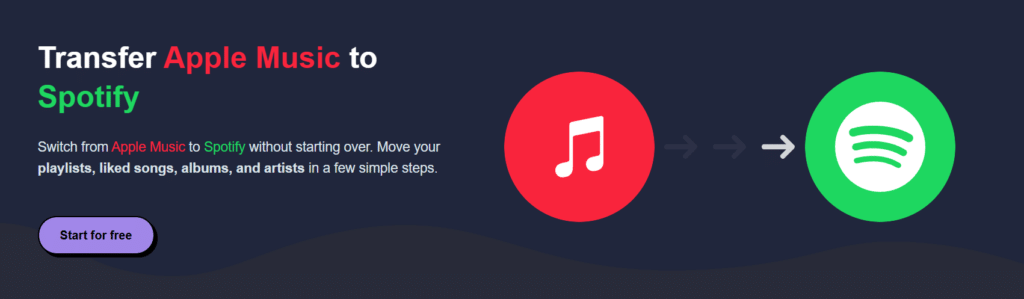
Do you want to listen to a playlist from TIDAL, Deezer, YouTube Music, or elsewhere on your Spotify account? Use our playlist synchronization tool, and you’re all set. Want to import or export playlists to or from your Spotify account? Soundiiz lets you do exactly what you want in seconds.
Our tools are designed to make your life easier. They allow you to manage and manipulate your streaming data in every way imaginable.
And that’s not all! Soundiiz goes further, becoming the perfect companion for your music listening, regardless of which streaming platform you use daily.
See for yourself—it couldn’t be easier: head over to Soundiiz and let us guide you!